A Tradition of innovation

research and development at WASA.
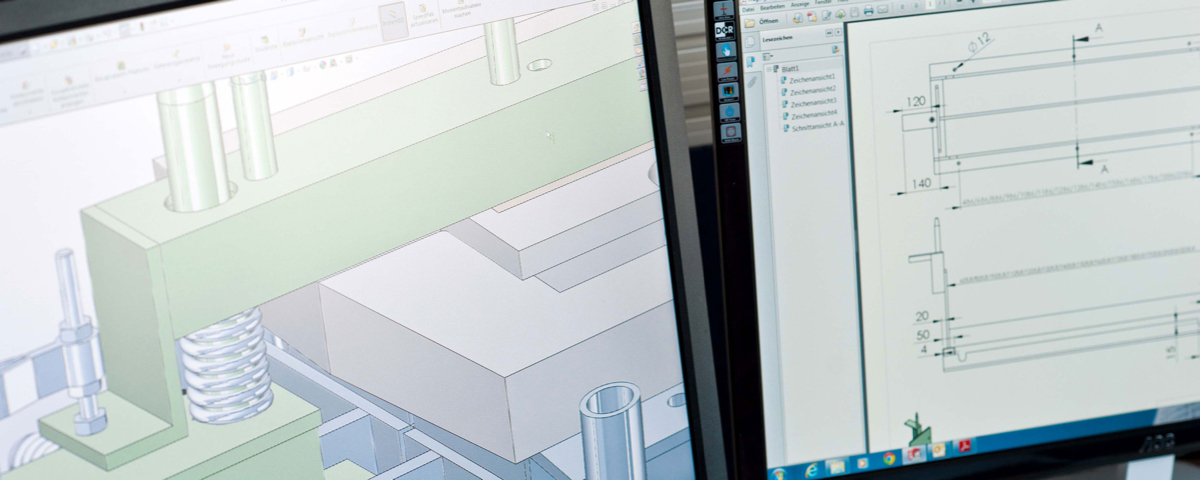
Innovation requires effective and efficient research and development. Here, too, WASA is well-positioned: With an in-house team of engineers, process engineers and business IT specialists working closely with external partners, we develop sustainable solutions for our customers every day.

Research is integral to WASA’s corporate philosophy, as only through continuous development can we maintain and expand our expertise over the long term. Driven by our pursuit of perfection, we work tirelessly every day to not only meet our customers’ needs and expectations, but to exceed them – today and tomorrow.

To achieve this goal, WASA works hand-in-hand with a range of universities, institutes and research partners. Over the years, close relationships have grown, deepened by every new research project.

In the research project “Schwingungsdämpfungssystem für Vibrationsmaschinen auf PU-Basis (PU Feder-Dämpfer-Element)” [PU-Based Vibration Damping System for Vibration Machines (PU Spring-Damper Element)],” WASA is developing improved polyurethane-based spring-damper elements in response to the persistent issue linked to conventional rubber spring elements, whose material properties frequently prove disruptive in vibration machine applications. Using a concrete block machine as a case study, the project aims to create function and quality-critical components of a vibration assembly marked by their greater durability, consistent spring properties that allow precise adjustments, and cost-effective, resource-efficient manufacturing processes. This project is co-funded by the European Union.

Meanwhile, the “WirelessAccel – drahtloses Vibrationsmesssystem” [WirelessAccel – Wireless Vibration Measurement System] project is developing a wireless multichannel acceleration measurement system specifically designed for concrete block machines. It enables real-time monitoring of highly dynamic vibrations during the compaction process and allows precise adjustments to production parameters. At the same time, the system supports the use of low-cement formulations and recycled materials. In this way, WirelessAccel contributes to lower CO₂ emissions and a more sustainable manufacturing of concrete products. The project is being carried out together with the IAB Institute for Applied Construction Research (IAB Weimar gGmbH), Synantik GmbH and the IMMS Institut für Mikroelektronik- und Mechatronik-Systeme (IMMS gGmbH). It is funded by the Free State of Thuringia and co-financed by the European Union under the European Regional Development Fund (ERDF).

Another key area of research is “Digitalisierte Fertigungstechnologie für Wetcast-Formen” [Digitalised Production Technology for Wetcast Molds]. As part of this project, WASA is developing a sustainable, digitally supported process for producing textured concrete block molds. Natural surfaces are captured via 3D scanning and used as a digital twin for the additive manufacturing of near-net-shape PU matrices. Flexible formwork mats with a foam core reduce material use and weight, while continuous comparison with the digital twin safeguards quality throughout the process.

The project is also investigating the use of recycled polyurethane, CO₂-optimized PU formulations, automated spray technology and a biocompatible, water-based release agent. The goal is to make wetcast mold production for the concrete block industry more resource-efficient, lower in emissions and more productive overall.

Additional research projects are being carried out in parallel with the University of Kassel and Chemnitz University of Technology.